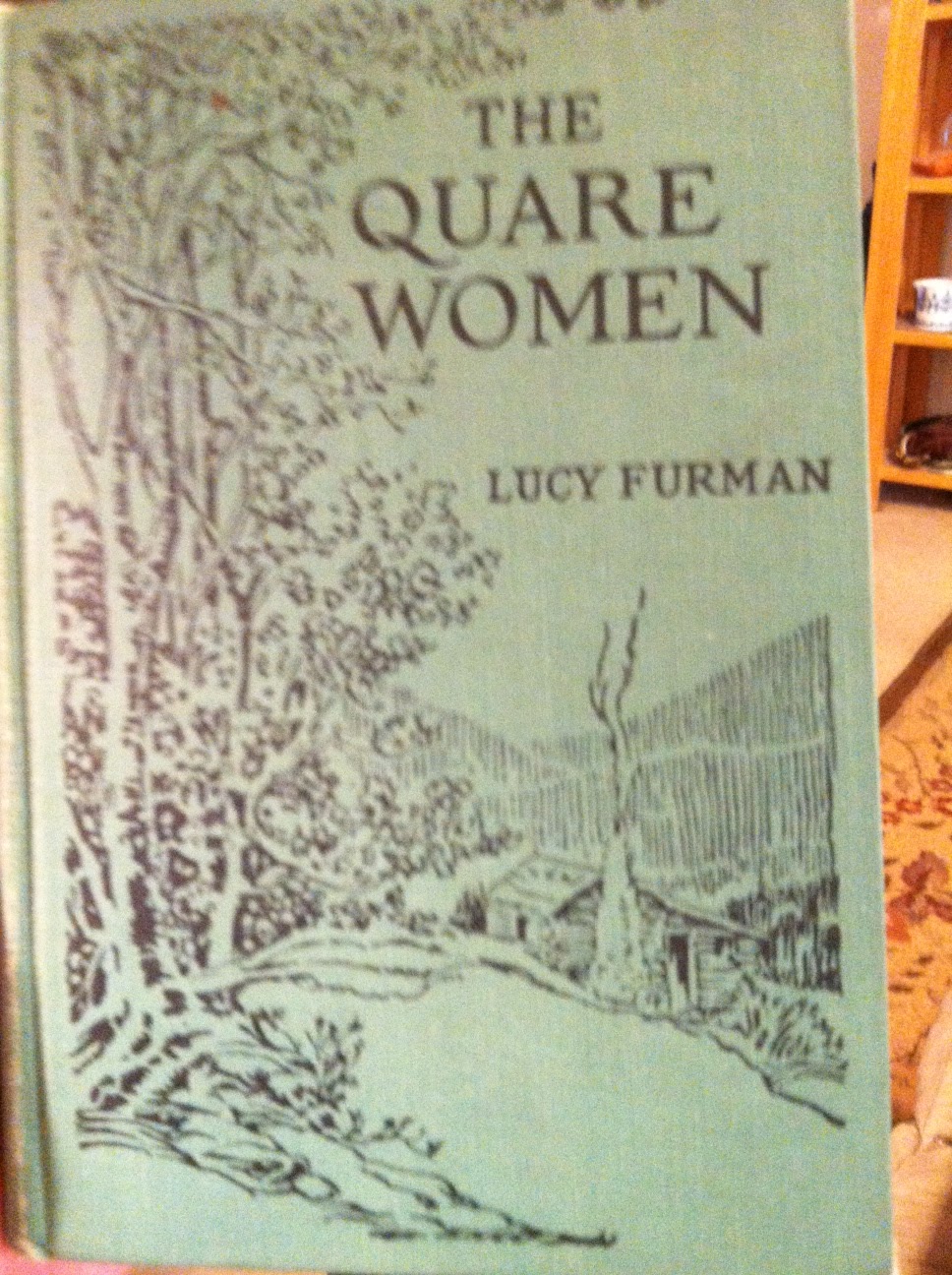
I finally read all of this novel with the intriguing title. The "Quare Women" of the title refers to the "passel of quare women come in from furrin parts," settlement workers who come to the remote mountain town of Troublesome to teach basic skills, cooking, hygiene, as well as arts and crafts. The novel includes points of view of both the locals as well as the outsiders, though the "locals" are made distinct through their dialects. (Surely, women from "level country" of Kentucky would have some sort of dialect as well.)
The novel is based on Furman's own experiences with the Hindman Settlement School in Knott County, Kentucky. What I most appreciated about the novel was that it didn't blame the mountaineers troubles--violence and poor health being two of the primary ones--on some sort of innate character, but on its isolation and lack of education. Uncle Ephraim, the town elder, gives a speech to that effect, explaining that when their ancestors settled there, they were educated people-but over time, as their isolation led to less and less education and contact with the progress of the outside world, the new generations were more prone to violence, to excess drinking, and to needless death from illness. Though there is resistance at first, even the most adamantly opposed to the outside influences, such as Uncle Lot, for example. Lot is sure that they're an example of the kind of "strange women" warned against in the Bible by Solomon: "The lips of a strange woman drop honey, and her mouth is smoother than butter; yea, the furrin woman is a norow pit, and they that are abhorred of the Lord shall fall therein'" (24). Eventually, however, even Uncle Lot admits that theirs is a beneficial influence, as not only do they bring medicine to treat typhoid, but the activities they bring have such a good influence that they bring a truce to the long-running mountain feud.
Though they are "quare," these women are not unattractive. In fact, part of what makes them "quare" is the fact that they are are so pretty and yet unmarried, some of them nearing thirty. As most of the mountain women are married and procreating by the age of 15, to be unmarried and 28 is unheard of. However, the mountain women who do marry young have difficult lives, which is reflected in their faces. Cynthy, for example, looks older than her mother Ailsie: "Cynthy's face being so lined and drawn from the troubles she had had as Fighting Fult's wife and widow" (46). People's visages reflect their home and geography. As Isabel rides the train further and further into the mountains, she observes that, "The progressive change in the people who got into and off the train all along the way was as striking as the changing topography. It was hard to believe that all could belong to the same state" (64).
It felt almost like cheating to read such a straight-ahead narrative as the novel from 1923. Part of the experience was simply the aesthetic experience of reading such a beautiful book:
I was expecting the quare women to be uglier, to reflect the southern idea that ugliness is a sign of intellectualness. Instead, this book is more suitable for my chapter on ugliness as "history marked on the body." A fun read, despite the dialect.
Showing posts with label body. Show all posts
Saturday, August 17, 2013
Saturday, July 21, 2012
Jonathan Ned Katz--The Invention of Heterosexuality (1995)
Katz’s text builds on the gay studies movement of the 1970s, especially works by Joseph Epstein and Foucault. After his work on recovering a history of homosexuality, in this text he moves on to challenge three “arguments [about] our idea of an age-old heterosexuality: (1) a procreate-or-perish imperative makes heterosexuality a necessity everlasting; (2) all societies recognize basic distinctions between human females and males, girls and boys, women and men—those biological and cultural differences are the source of an immortal sexuality that is hetero; (3) the bodily pleasure generated by female and male conjunctions remains the unchanging basis of an eternal heterosexuality” (14). He goes on to claim that “heterosexuality is not identical to the reproductive intercourse of the sexes; heterosexuality is not the same as the sex distinctions and gender differences; heterosexuality does not equal the eroticism of women and men. Heterosexuality, I argue, signifies one particular historical arrangement of the sexes and their pleasures” (14). Katz also distinguishes between “sexual reproduction, sex difference, and sexual pleasure,” noting that they “have been produced and combined in different social systems in radically different ways” (14). Katz also acknowledges not only what he has gained from recent feminist approaches to history, especially the awareness of how gender, race, and status have influenced the narratives which have been told and assumptions which have been made about heterosexuality.
He begins with the work of doctors like Krafft-Ebing at the turn of the century, who took a medical approach to sexuality. It was at this point (in the 1890s) that the idea that the sexual instinct was identified as a procreative desire was being challenged by “a new different-sex pleasure ethic” (19). In his discussion of Kraff-Ebing, he points out that “the term ‘contrary sexual feeling’ presupposed the existence of a non-contrary ‘sexual feeling,’ the term ‘sexual inversion’ presupposed a noninverted sexual desire. From the start of this medicalizing, ‘contrary’ and ‘inverted’ sexuality were problematized, [while] ‘sexual feeling’ was taken for granted” (55). After Krafft-Ebing comes Freud, who put pleasure—rather than reproduction—at the center of human sexual feeling and behavior. Importantly, Freud’s ideas of the libido, drives, instincts, and impulses demonstrate a “desire for psychic satisfaction experienced in the flesh” (61). I think this may be a very important point in terms of embodiment themes in literature. However, Katz also notes that “Freud innovatively proposes the original and complete independence of erotic desire and erotic object” (61)—an important innovation, but one which requires careful consideration, because it’s easy to fall into a solipsistic way of thinking, failing to taking concepts such as intersubjectivity into account.
After discussing the solidification of the other-sex pleasure centrality to twentieth-century sexuality and its role in cementing heterosexuality as the normative mode (as well as the change in understanding of heterosexuality from its existence as a medical term meaning morbid attachment to nonprocreative sexuality to its meaning today, Katz turns to the feminist contribution to the critiquing and problematizing of heterosexuality, observing that much feminist work (looking at specifically at liberal and radical feminist commentaries from 1963 and 1975) “critically probe not only male supremacy but the social arrangement of heterosexuality” (113). While Katz is a fan of second wave feminist critiques of heterosexuality, he observes that many of these critics (such as Monique Wittig, to name only one) “fall[] prey to the equation of heterosexuality with reproduction,” failing to see that pleasure-oriented, Freudian heterosexuality is actually at the heart of the heterosexual social organization of which they otherwise provide incisive critiques (157). Ultimately, Katz says that,
I don’t think that the invention of the word heterosexual, and the concept, created a different-sex erotic. I do think that the doctors’ appropriation of the word and idea of heterosexuality newly and publicly legitimated the previously existing but officially condemned different-sex eroticism of the middle class. The word heterosexual, and the concept, then helped to re-create this sexed eroticism as, specifically, “heterosexual” within a new, specifically “heterosexual” society. (181).
Katz’s vision of modern-day heterosexuality is one that ultimately emerged out changing view of sexuality from a nineteenth century understanding of sexual desire as based in procreation to one (and one specifically attributed to a rising American middle class with falling birth rates and rising divorce rates) which had pleasure at its center. Katz goes even further in his conclusion, claiming that “Heterosexual and homosexual refer to a historically specific system of domination—of socially unequal sexes and eroticisms” (189). As “feminists have recently shown us that sexual anatomy does not determine our gender destinies…neither does biology determine our erotic fates” (190).refer to a historically specific system of domination—of socially unequal sexes and eroticisms” (189). As “feminists have recently shown us that sexual anatomy does not determine our gender destinies…neither does biology determine our erotic fates” (190).
Labels:
Adrienne Rich,
body,
feminism,
Foucault,
heterosexuality,
Jonathan Ned Katz,
queer history,
queer theory,
second wave feminism,
sexuality
Saturday, May 19, 2012
Flannery O'Connor--A Good Man is Hard to Find (1955)
A Good Man is Hard to Find is O’Connor’s first collection of short stories, which followed her first novel, Wise Blood, in 1952. This collection includes both “A Good Man is Hard to Find” and “Good Country People,” two of my favorite of her stories. Its stories contain over references to what O’Connor referred to as the “Christ-haunted South,” such as the story “A River, in which a young white boy is taken to a river baptism by his babysitter Mrs. Connin. The childish point of view in “A River” provides a sardonic and yet tragic take on charismatic religion, as the boy finds Mrs. Connin’s religious ceremony quite educational: “He had found out already this morning that he had been made by a carpenter named Jesus Christ. Before he had thought it had been a doctor named Sladewall, a fat man with a yellow mustache who gave him shots and thought his name was Herbert, but this must have been a joke….If he had thought about it before today, he would have thought Jesus Christ was a word like “oh” or “dam” or “God,” or maybe somebody who had cheated them out of something sometime” (160). He is so inspired by the baptism that he finds his way back to the river to baptize himself, and the story ends with him being carried downstream alone.
In “The Life You Save May Be Your Own,” one-armed Mr. Tom T. Shiftlet from Tarwater, Tennessee, appears at the home of Lucynell Crater and her deaf adolescent daughter by the same name. The one-armed man fixes things around their home, works on their dead car, and teaches the deaf girl to say words. The mother arranges Mr. Shiftlet’s marriage to the daughter, negotiating a price for the Shiftlet to take her daughter, throwing in the car and the farm. After their marriage at the courthouse, Shiftlet abandons the girl at a diner on their alleged honeymoon in a strange, short story which reverberates with the male abandonment in “Good Country People.”
Several stories make reference to the effects of war, particularly WWII. In “A Stroke of Good Fortune,” Ruby deal with her shiftless brother Rufus, back from but seemingly unchanged by the European Theater. In “A Stroke of Good Fortune,” Ruby, like Shiftlet, contemplates the possibility of life without a heart as she denies her actual state of pregnancy. The two women in “A Circle in the Fire” cite the atrocities in Europe as things to be grateful for are happening at a distance. “A Late Encounter with the Enemy” follows General Sash, 104-year-old veteran whose appearance in his military regalia makes him a symbol of “old traditions! Dignity! Honor! Courage!” (253). The General was not actually a general, but a soldier in the Civil War, and has no memory of that, losing a son in the Spanish-American War, or other history than receiving his uniform twelve years ago for the premiere of Gone with the Wind. And in “The Displaced Person,” Mrs. McIntyre struggles to cope with the changes wrought by the arrival of refugees from Poland. She is able to adapt only to a certain extent, however; while she tolerates the idea of locals marrying Polish people in order to bring them over, when the displaced people try to marry local black people, a line is crossed. She watches Mr. Guizac, the Polish man who attempts to arrange this marriage, be run over by a tractor, and fails to alert anyone to the accident before it happens.
“A Temple of the Holy Ghost” has an interesting vision of female ugliness:
All week end the two girls were calling each other Temple One and Temple Tow, shaking with laughter and getting so read and hot that they were positively ugly, particularly Joanne who had spots on her face anyway. They came in the brown convent uniforms they had to wear at Mount St. Scholastica but as soon as they opened their suitcases, they took off the uniforms and put on red skirts and loud blouses. They put on lipstick and their Sunday shoes and walked around in the high heels all over the house, always passing the long mirror in the hall slowly to get a look a their legs. (197)
These girls are described as boycrazy morons, so once again, ugliness is a marker of female sexuality. Although this is the judgment of the twelve-year-old narrator, she, too, is described as ugly, though more in her behavior than in her appearance. After the cook asks why she must be so ugly all of the time, she connects her ugliness to her being too smart for her own good (203). In this story, the older girls ridicule the notion of their bodies as “temples of the holy ghost” as their convent teachers insist; the narrator, on the other hand, in her interest in becoming a saint, contemplates her own body’s abilities to be an actual temple in her pursuit of sainthood.
“The Artificial Nigger,” like many of the stories in this collection, depicts country people unable to handle modernity. Mr. Head, from a rural area of Georgia where they’ve run all of the black people out, takes his grandson Nelson to Atlanta in an attempt to introduce Nelson to the wonders of the big city. They are so out of their element, however, that they become lost and desperate. Nelson’s life in the country has been so sheltered that he has never seen a person of color, and he is overwhelmed by the black people he encounters in Atlanta. At the end of the story, they see what to the reader is an offensive stereotype statue of a black man eating watermelon. However, to Mr. Head and Nelson, this statue is terrifying; as Mr. Head notes, “They ain’t got enough real ones here. They got to have an artificial one” (230).
Throughout these stories, themes of rural people who have trouble adapting to a changing world repeat. The cultural clashes are often race-based (as “The Displaced Person” reveals, such race-based conflicts are not always Caucasian versus African-American), and the conflicts usually have extreme, grotesque results. Certainly, there is a strong threat of dark humor which runs throughout, but it is a usually tied to the grotesque in some way.
Labels:
body,
Christianity,
Flannery O'Connor,
grotesque,
southern gothic,
Southern literature,
southern women writers,
violence
Saturday, April 21, 2012
Kathryn R. Kent--Making Girls Into Women: American Women's Writing and the Rise of Lesbian Identity (2008)
Starting with the line
from Little Women, in which Jo
proclaims, “Mothers are the best
lovers in the whole world, but I’d like to try all kinds,” Kathryn Kent looks
at how the changing women’s culture at the turn of the century allowed for a
new kind of emergent lesbian subjectivity.
Using authors such as Alcott, Gertrude Stein, Marianne Moore, Elizabeth
Bishop, Harriet Beecher Stowe, as well as the Girl Scout Handbook, Kent claims
that these texts illustrate how a new semi-public, semi-private modality of
space provided by scouting, boarding school, and similar entities allowed for a
new kind of female-female bonding, an alternatively queer maternal one.
These texts reflect the
growth of commodity capitalism in America, which was reflected in the urge for
taxonomy and categorization at the time.
For example, Kent points out how the rise of the department store and
catalogue “organizes or teaches consumers a specific kind of consumption.” In addition to the kind of sexological
categorization which was occurring at the time, Kent shows how commodity
capitalism “demonstrate[s] another kind of codification of gender and sexuality
occurred at the turn of the century: there are newly gendered ‘needs’ and ‘desires’
that are supposed to reflect the binary gender oppositions of compulsory
heterosexuality.” Importantly, “the
domestic sphere serves within this system as a site for the production and
reproduction, through consumption and display, of these norms” (149). By showing the similarities between the
category-driven subject-formation of the Girl Scout handbooks and novels of the
1920s (for example, she looks at the second edition of Scouting for Girls was published in 1920) and Djuna Barnes’s 1928 Ladies Almanack. Kent identifies that, “In ways analogous to
the Girl Scouts, the Almanack explicitly
connects theories of mass production with the production of sexual subjectivity
and also sees reading as a form of erotic recruitment” (126)—an observation
which I have seen confirmed many times in literature, especially from this time
period (including work by Virginia Woolf, in Radclyffe Hall, and even, I would
argue, Quentin Crisp’s “Crisperanto”).
Much of this book works
to critique and reconfigure the traditional oedipal configuration. According to Kent, the “limits of the oedipal
trajectory” include the inability to “view identification and desire and
compatible” (101). In other words,
traditional oedipal understandings of desire do not take into account that one
can both with to be as well as wish to be with another; identification and
desire are not mutually exclusive. This
observation opens up entirely new ways of reading not only these texts of Sapphic
modernism, but also more generally readings of romance fiction and even
pornography. In her discussion of the “pleasures
of influence” between Marianne Moore and Elizabeth Bishop, for example, she identifies
what she refers to as a “queer erotics of relation, or what I term ‘invitation,’
an erotics not based in subsuming the difference of the ‘other,’ but in
preserving it” (210). In looking at
Moore and Bishop relative to such “queer erotics,” Kent is able to tie this
dynamic to both their individual relationship as well as its connection to a
larger dynamic of nationhood: “in moving from Moore to Bishop we shift from
what I have argued the problems of the erotics of identification—the fact that
such identification is often inseparable form other forms of imperial
recruitment—to an erotics that tries to resist this impulse to reform the ‘other’
or the self” (210). Again,
subject-formation illuminates the fuzzy interstices of the public and the
private.
Labels:
American literature,
body,
comps,
gender,
girls,
women's sphere
Saturday, April 14, 2012
Alice Walker--The Color Purple (1982)
Walker’s third novel, The Color Purple won the 1983 Pulitzer Prize for literature. An epistolary novel, it consists of letters written by Celie—first to God, then to her sister Nettie—and her sister Nettie to Celie. In it, Celie tells of her sexual abuse by her father (or stepfather, as she later discovers), her marriage to Mr. _______, who marries her to find a caretaker for his children while he moons over his true love, the singer Shug Avery, and Celie’s own sexual awakening with Shug. Meanwhile, Nettie also escapes from their family, and winds up going to Africa with Samuel and Corinne and their two adopted children (who are actually Celie’s offspring, the product of her stepfather’s rape). The novel ends with an emotional reunion between the sisters and their families.
From the beginning of the novel, Celie is described as “ugly”: her Pa, when trying to convince Mr. _______ to take her off his hands by marrying her, tells him frankly that “She ugly.” Though Mr. _____ is more interested in Celie’s sister Nettie, their Pa is determined to marry of Celie first: “She ugly. Don’t even look like she kin to Nettie. But she’ll make the better wife. She ain’t smart either, and I’ll just be fair, you have to watch her or she’ll give away everything you own. But she can work like a man” (18). At this point, Celie has already described her frequent rape by her Pa, and that she’s already born two of his children (which he has killed). This knowledge of her molestation provides an odd context for her Pa’s characterization of her as ugly, a description which implies a certain kind of de-feminization of Celie, as her Pa describes her as able to work “like a man.” And again, when Celie first sees Shug Avery, Shug’s first reaction to Celie (Shug herself being sickly and described in unattractive terms: “Under all that powder her face black as Harpo. She got a long pointed nose and big fleshy mouth. Lips look like black plum. Eyes big, glossy. Feverish. And mean” (50)) is to confirm Celie’s ugliness: “She looked me over from head to foot. Then she cackle. Sound like a death rattle. You sure is ugly, she say, like she ain’t believed it” (50).
Importantly, though, at this point we still don’t know much about Celie’s appearance; when she tries to change her dress before Shug arrives, she admits that, “a new dress won’t help none with my notty head and dusty headrag, my old everyday shoes and the way I smell” (49). Toward the end of the novel, Celie looks in the mirror and sees, “My hair is short and kinky because I don’t straighten it anymore. Once Shug say she love it no need to. My body just any woman’s body going through the changes of age. Nothing special here for nobody to love. No honey colored curly hair, no cuteness. Nothing young and fresh” (229). Despite her characterization as “ugly” by other characters, Celie herself sees nothing incredibly out of the ordinary in her physical appearance. So, even though Walker gives physical descriptions of other characters, Celie’s characterization of “ugly” seems primarily based on her clothing and ability to work “like a man,” perhaps characterizations which to a certain extent mark her as failing to conform to expected gender norms. When combined with her own attraction to women, it seems as if the characterization of “ugly” is more related to her sexual and gender noncomformity than any particularly marked or noticeable physical characteristics. It is her gender noncomformity which people read on her body.
When Celie is talking to Sofia (her stepson Harpo’s wife), Sofia tells her, “The Lord don’t like ugly,” to which Celie replies, “And he ain’t stuck on pretty” (46). This exchange then “open[s] the way for our talk to turn another way,” and they’re able to share more with each other. In this early work, Walker seems to be anticipating the middle way of the Buddhism about which she would write much more explicitly in years to come. Though Walker has been criticized for her portrayal of the black men in this novel, for creating unflattering portraits of violent men who rape and beat their children, I think that such a reading is missing what I read as an important dynamic quality to these characters. By the end of the novel, Mr. _______ has changed enough that he and Celie become friends: partly united through their joint love of Shug, but also through Mr. ______’s maturity and realization of his past wrongs. Celie’s Pa dies and leaves his house to her; while as a reader, this gesture is not enough to make me forgive him for his abuse of Celie, it is more than I had expected of him.
Labels:
African American literature,
Alice Walker,
body,
gender,
homo-ness,
homosociality,
queer south,
rape,
sexuality,
Southern literature,
southern women writers,
ugly women
Friday, March 23, 2012
Carson McCullers--The Heart is a Lonely Hunter (1940)
This beautifully moving novel was McCullers’ first. It takes place in a mill town in Georgia in the 1930s, and primarily follows the character of John Singer, a deaf mute man, and the people who are drawn to him. This group—Mick Kelley, a very poor young girl whose head is filled with music; Dr. Copeland, an African-American doctor slowly dying of tuberculosis, whose idealism has alienated him from his community; Jake Blount, a drunk carnival worker, who tries to preach a message of Marxism; and Biff Brannon, a widowed cafĂ© owner. Singer’s muteness enables this group of outcasts to confide in him, filling in his character in whatever capacity best suits them. Mick, who suffers from hunger and poverty, both confides her secret fears and dreams in him, as well as relying on his radio to bring her the classical music with which she is consumed. Dr. Copeland, who gave his children names like Portia and Karl Marx, works tirelessly ministering to people with lungs weak from mill work who can’t afford to pay him; Singer is the first (and only) white man who has ever treated him simply as another person, not another black person. Jake recovers from a nasty drunk in Singer’s room, and continues to confide his class-based frustrations to him. And Brannon, especially once his wife dies, finds Singer’s room to be a place of comfort.
Though all of these characters consider Singer to be their closest friend, the only person with whom Singer similarly pursues a friendship is his former roommate Antonapoulos, a deaf-mute man who falls ill and is eventually institutionalized after his illness changes him, leaving him mentally unstable. Singer spends his life devoted to his friend, regularly spending his vacation travelling to see the Greek (as he is often referred to) at the hospital, despite Antonapoulos’s apparent disregard for his friendship. Singer signs and signs to Antonapoulos, without ever receiving a reciprocal acknowledgment. At the end of the novel, Singer travels to the hospital only to discover that Antonapoulos is dead. Encountering three other bowler-hatted deaf-mute men in a bar near the hospital, Singer tries to join them, but is politely excluded from their conversation. After this encounter, Singer returns home and kills himself.
As the novel takes place in the 1930s in a small southern mill town, poverty is a disturbing fact of life. McCullers gives unromanticized details about the extent of poverty, noting not only the lengths to which the poor must go in order to eat anything, but also presents rather straightforward information about what poverty like that faced by the Kellys looks like:
Money was the main thing. All the time it was money, money, money. They had to pay through the nose for Baby Wilson’s private room and private nurse. But even that was just one bill. By the time one thing was paid for something else always would crop up. They owed around two hundred dollars that had to be paid right away. They lost the house. Their Dad got a hundred dollars out of the deal and let the bank take over the mortgage. Then he borrowed another fifty dollars and Mister Singer went on the note with him. Afterward they had to worry about rent every month instead of taxes….Bill had a job in a bottling plant and made ten dollars a week. Hazel worked as a helper in a beauty parlor for eight dollars a week. Etta sold tickets at a movie for five dollars” (238).
From there, she explains who pays for what, and how even lunch has become a luxury, and how “sometimes she and George were downright hungry for two or three days” (239). By the novel’s end, Mick has left school and taken a job at Woolworth’s, a step which she realizes even as she’s making it is closing off any other future possibilities, that she is being “trapped by something….Once they were used to the money coming in it would be impossible to do without again. That was the way things were” (318).
While Jake identifies the root of the area’s economic problems on capitalism in general, he also sees this poverty as a particularly regional one: “At least one third of all Southerners live and die no better than the lowest peasant in any European Fascist state….Who owns the South? Corporations in the North own three fourths of all the South….For under this system pigs are valuable and men are not” (298). It is in this way that the theme of poverty is tied to larger themes of regionalism and racism in the novel, as demonstrated by a conversation between Jake and Dr. Copeland. In response to Jake’s monologue about the inherent inequalities of capitalism, Dr. Copeland responds, “you are giving no attention to the very separate question of the Negro….it is impossible to see the full situation without including us Negroes” (298). Jake continues to talk about Fascism, to which Dr. Copeland replies, “So far as I and my people are concerned the South is Fascist now and always has been” (299). In fact, the rise of European Fascism allows for several characters to make comparisons between Fascist anti-semitism and American racism. Once again, Dr. Copeland: “The history of my people will be commensurate with the interminable history of the Jew—only bloodier and more violent” (299). Throughout most of his life, Dr. Copeland has believed in an ideology of uplift. As his friend Marshall Nichols explains, “it behooves us to strive with care and not endanger this amicable relationship already established. Then by gradual means a better condition will come about” (293). After his son loses his legs because of mistreatment in prison, and he himself is beaten and jailed after trying to find justice for his son at the courthouse, however, Dr. Copeland begins to question his methodology. Unfortunately, by the time he makes this realization, his health is so deteriorated that he leaves the town to be taken care of by his extended family in the country. He leaves Jake with a message of solidarity, that social change will only come from working with others—and it is such solidarity which Jake seeks at the novel’s end, solidarity through the type of community which Jake is sure is unique to the South.
And finally, in terms of my own research, there are some interesting points about ugliness and beauty in women (or, more specifically, girls). For most of the novel, Mick is described as a tomboy, wearing boy’s shorts and with hair in constant cowlicks. Occasionally—such as for her prom party—she dresses up in her sisters’ clothes and wears make-up, but in these scenes she often appears almost as in drag. The sexual awakening she experiences with Harry, however, marks something of a turning point in her appearance, as shortly after this scene—in which Harry haltingly admits, “Listen here. I think you’re so pretty, Mick. I never did think so before. I don’t mean I thought you were very ugly—I just mean that—“ (273)—Mick takes on the adult responsibilities of a job at Wooltworth’s, to which she starts wearing stockings and jewelry, more properly inhabiting the costume of a woman. After her physical intimacy with Harry, Mick is sure that the changes she has undergone can be read from her face; she is sure that her sexuality must be marked on her body. However, her mother’s response to her physical appearance in this scene is only to tell her to “Quit frowning like that, Mick. You’re coming to the age where you ought to fix up and try to look your best you can” (278).
Even more intriguing are the changes which happen to Baby, Biff’s niece and child performer, whose beauty is destroyed in a freak gun accident. Her (former stage) mother Lucile confides to Biff that,
If a child is kept clean and well cared for and pretty then that child will usually be sweet and smart. But if a child is dirty and ugly then you can’t expect anything much. What I’m trying to get at is that Baby is so shamed over losing her hair and that bandage on her head that it just seems like it makes her cut the buck all the time. She won’t practice her elocution—she won’t do a thing. She feels so bad I just can’t manage her (231)
Once again, there is a connection between inner and outer virtue, and in this configuration it’s not a person’s moral character which shines through to her outer appearance, but rather the outer appearance which influences the inner character. The surface is understood to be a marker of the inside—to Mick, who assumes that an inner change must be marked on the outside, or to Lucile, who thinks that changes to physical appearance affect the character inside. It would be interesting to compare the behavior of Baby to that of Dorothy Allison’s Shannon Pearl, whose physical disfigurement seems to have given her a horrid character.
Labels:
beauty,
body,
Carson McCullers,
class,
Dorothy Allison,
freaks,
girls,
reading list,
sexuality,
southern gothic,
Southern literature,
southern women writers,
ugliness,
ugly women
Subscribe to:
Posts (Atom)
